When Outrage Becomes Obsession: How Cult Mentality Shapes What We Pay Attention To
We live in an era where news spreads faster than ever, and yet our sense of proportion seems smaller than ever. Some stories dominate headlines, comment sections, and dinner table conversations for weeks, while others, arguably more important and more impactful, slip by without so much as a whisper. Why?
The difference usually is not the scale of the event. It is not even about morality or global significance. It is about emotional charge. When a story hooks into fear, outrage, or identity, it spreads. And when people repeat it endlessly, amplifying its importance beyond all else, we start to see the outline of something familiar: cult mentality.
Psychologists and media researchers have been tracking this for years. A study on social media content found that posts framed in moral terms, especially when they provoke anger, are more likely to go viral than neutral information. The Decision Lab notes that moral outrage online is contagious because it spreads not just when people agree, but because they feel compelled to signal that they agree.
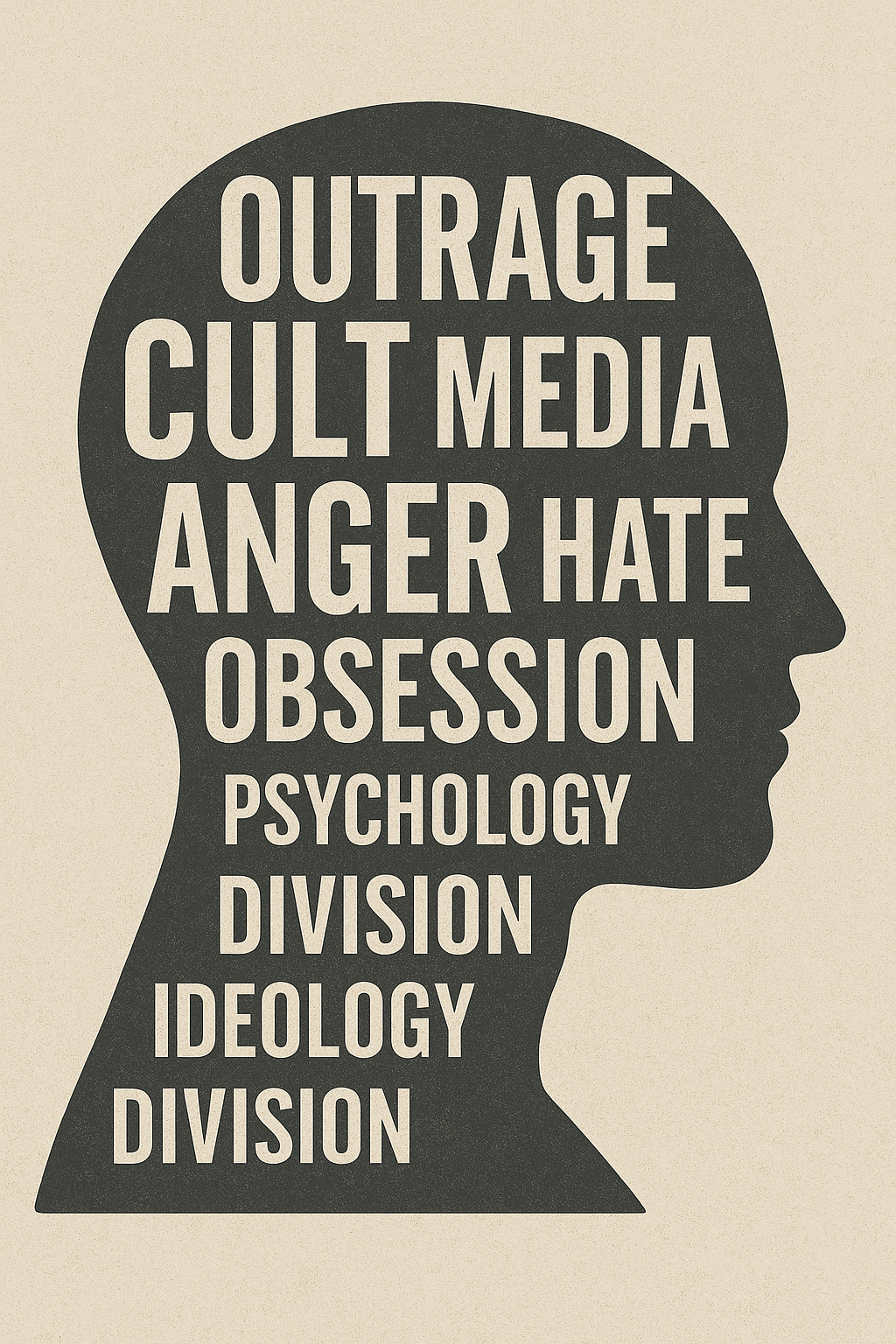
Image Credit: DALL-E
This is the foundation of what is sometimes called the outrage industrial complex. Media companies, influencers, and even regular users realize that outrage is the cheapest form of engagement. It is faster to spark anger than to inspire reflection. It is easier to provoke fear than to encourage understanding. And in a world where attention is currency, outrage is a shortcut to clicks, shares, and views.
Psychology Today has written about why we are so captivated by bad news: it activates our threat detection systems. In evolutionary terms, noticing danger kept us alive. But in the modern world, it means negative headlines pull us in harder than positive ones, even if the actual event is not as significant as it feels in the moment.
The result? We keep scrolling, consuming, and amplifying anger. And the more we do, the more platforms serve us similar content. It becomes a loop: outrage leads to engagement, engagement leads to more outrage.
Research on Twitter (now X) has shown that outrage posts do not just spread quickly, they reinforce themselves. When users see that their anger-driven posts get likes and shares, they are more likely to post in the same tone again. Axios once called this the “online outrage feedback loop,” and it perfectly captures the dynamic: emotion rewarded becomes emotion repeated.
What is more, studies suggest that anger spreads faster than joy online, and across more diverse groups of people. That means outrage does not just echo in existing communities; it leaps out into new ones, drawing fresh audiences into the cycle.
This is not accidental. Social platforms are built to amplify emotional content because it keeps us hooked. The more time we spend reacting, the more ads we see. Our attention is being engineered, not guided.
What makes this especially tricky is that our own brains are complicit. We do not just consume outrage, we filter it through cognitive biases that exaggerate its impact.
Agenda-setting theory explains that media does not tell us what to think, but it does tell us what to think about. When certain stories dominate every screen and feed, our brains tag them as “important,” regardless of their real-world scale.
Then there is the frequency illusion. When we notice something once, we suddenly feel like we see it everywhere. A name, a phrase, a headline keeps popping up, and we assume it is a global fixation. In reality, it is often just repetition magnified by algorithms.
And the hostile media effect adds another twist. When people already hold strong beliefs, they often perceive neutral reporting as biased against them. That means even balanced coverage can feel like an attack, fueling more outrage and mistrust.
Combine these together, and it is no wonder so many people are living inside echo chambers. Their feeds show them the same stories, their brains confirm the importance of those stories, and every attempt at neutrality feels like hostility. It is not a recipe for clarity, it is a recipe for obsession.
At a certain point, the behavior around these stories starts to resemble cult psychology. This does not mean every group is literally a cult, but the patterns are similar:
Idolization: Treating one figure, one narrative, or one event as more important than anything else in the world.
Selective attention: Ignoring larger, global events while hyper focusing on details that reinforce the chosen narrative.
Us vs. Them thinking: Dividing people into insiders and outsiders, and fueling hostility toward those who do not “get it.”
Loss of perspective: Values, faith, or even logic get sidelined when loyalty to the narrative takes over.
Psychologists note that anger and fear are addictive, not just reactions. They come with dopamine spikes. Every time we argue in a comment thread or share a viral outrage post, our brain rewards us with a hit of stimulation. In that sense, outrage functions like a drug, one that keeps people coming back even when it is exhausting.
This is why some groups can treat a relatively small story like it is the most important thing in the world, while ignoring events of far greater significance. It is not about truth; it is about the emotional payoff.
This obsession does not just waste attention, it reshapes communities. When people spend their days amplifying outrage, conversations narrow. The world feels smaller because everything is filtered through the same lens. Division deepens, because constant anger requires an enemy.
And the saddest part is that real values get lost in the noise. Morality, compassion, spirituality, even joy, are all crowded out by the rush of outrage. People are not grounded in community or faith anymore; they are grounded in cycles of anger.
This is not just an online problem. It bleeds into family dinners, workplaces, schools, and friendships. Entire relationships fracture because the obsession with one narrative has eclipsed the bigger picture of connection and humanity.
The good news is that we are not powerless in this. Awareness is the first step. If you can notice the cycle, if you can say, “This feels bigger than it is because outrage makes it feel bigger,” you have already created space to step back.
We can also practice media mindfulness:
Pause before sharing. Ask, “Is this meaningful, or just emotional bait?”
Diversify your inputs. Follow accounts or read sources that do not all sound the same.
Limit exposure. Outrage thrives on repetition. Less time scrolling means less fuel for the cycle.
Re anchor yourself. Spend more attention on things that do not require outrage, like art, nature, family, and small joys. These are not distractions; they are what keep us whole.
Perspective is the antidote to obsession. When you zoom out, when you see the bigger world, you remember that most things are not as earth shattering as they feel on a screen.
Outrage has its place. It can be a signal that something is wrong, that injustice needs to be addressed. But outrage should never become obsession. When it does, it starts looking less like truth and more like devotion, and not the healthy kind.
In the end, the world does not need more of us shouting into echo chambers. It needs more of us stepping back, widening our view, and reclaiming our attention for what truly matters. Outrage is cheap. Perspective is priceless.
If You Loved This, You’ll Love These Too:


Have You Heard The Latest Episode of GBRLIFE of Crimes?
GBRLIFE has so much more: